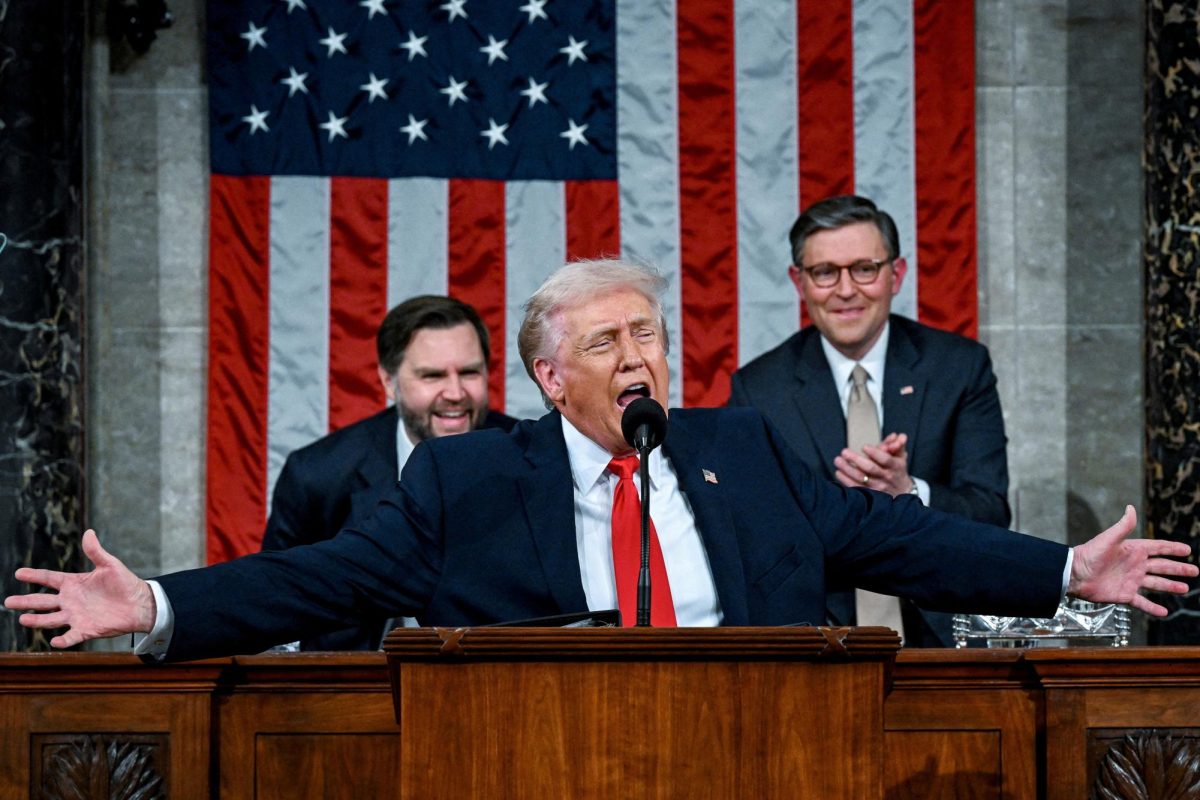
On Tuesday, February 25, President Donald Trump delivered his State of the Union address, lasting a record one hour and forty minutes, making it the longest in presidential history.
The annual address, given before a joint session of Congress (otherwise known as a formal gathering of both the House of Representatives and the Senate in the House chamber), is intended to outline the president’s priorities and assess the condition of the nation. This year’s speech focused heavily on immigration policy, economic growth, foreign policy, and cultural issues.
The State of the Union is a long-standing tradition in American politics. Article II of the U.S. Constitution requires the president to brief Congress about the state of the country and recommend measures they believe are necessary. Over time, this constitutional expectation has evolved into the modern televised address watched by millions of Americans each year.
During his speech, Trump emphasized economic policies that he said have strengthened American industries and job growth. Early in the address, he argued that his tariff policies, though controversial, have protected American workers and business from external competition. Many of Trump’s claims regarding the economy under his first year back in office included sharp epithets toward the Biden administration, as he drew bold comparisons and claimed that his administration had “driven core inflation down to the lowest level in more than five years,” simultaneously arguing that inflation had dramatically reduced since he took office. He also stated that “more Americans are working today than at any time in the history of our country.”
However, many of these claims were quickly examined by various news outlets and fact-checkers. Economic data shows that while inflation has decreased slightly during Trump’s current term (by about .2%), the decline began before he took office. Inflation peaked at about 9% under Joe Biden, a spike that is largely attributed to the outbreak of Covid-19, but had already dropped to just under 3% by the time Trump returned to office in 2025. By the end of the president’s first term, inflation has lowered, but not dramatically enough to credit new policies (Source: U.S Bureau of Labor Statistics).
In addition to economic policy, Trump devoted a significant portion of the address to immigration. He praised his administration’s efforts to increase border enforcement and argued that stricter immigration policies were necessary for National Security and economic stability. immigration has been one of the central policy issues of his presidency, and it remains a major topic of debate in Congress.
Throughout the speech, lawmakers from both parties reacted strongly–some applauding key moments while others openly voiced disagreement. At the mention of immigration policy, this division was particularly apparent, with half the room cheering while others remained seated in silent protest. Trump gestured mockingly to those seated, waiting until after the applause to say “Isn’t that a shame. You should be ashamed of yourself, not standing up,” prompting a loud response from Representative Ilhan Omar of Minnesota, who shouted “You have killed Americans” repeatedly as Trump continued. Congresswomen Ilhan Omar and Rashida Tlaib were among those who visibly protested throughout the speech, shaking their heads, speaking out from their seats, or declining to applaud.
Moments of tension like these are not unusual during State of the Union Addresses, which often highlight political divisions between parties. At several points in the evening, applause from Republicans contrasted sharply with silence of dissent from many Democrats.
Trump also discussed social policy issues that have become increasingly prominent in national politics. He criticized state policies regarding gender transition treatments, and argued that federal action was necessary to restrict such programs. The mention of religion and its “tremendous renewal” within the United States also earned Trump a standing ovation.
Seconds later, a segue to the late, right-wing debater and conservative activist Charlie Kirk cued another standing ovation. As is customary, Trump used his speech to recognize invited guests sitting in the gallery–one of whom was the recently widowed Erika Kirk.
For Americans watching at home, the State of the Union remains one of the largest political events of the year, allowing the president to communicate past achievements and frame future goals for Congress and the public. As Congress debates legislation in the coming months, many of the issues highlighted in Trump’s address will likely remain central in discussion.
Sources:
- Fact-checking Trump’s State of the Union claims on the economy, immigration and crime | PBS News
- CNN highlights key moments from Donald Trump’s historic State of the Union address
- Fact Check: The State of the Union | CNN
- Watch: President Donald Trump’s full State of the Union address
- Read Trump’s full 2026 State of the Union address | PBS News
- Highlights from Trump’s 2026 State of the Union speech
- Highlights from Trump’s State of the Union on Feb. 25, 2026 | AP News